Recently, the stock market has experienced big wins. Economists argue that this increase can be correlated to the fact that, in October, the consumer price index went down to 3.2 percent. The slowed consumer price index is rooted in a campaign by the Federal Reserve, which wishes to “kill inflation” by lowering rates. There is a big debate among economists concerning whether this upward-moving stock market can be backed by economic indicators.Continue Reading

Among other factors, the distribution of some $5 trillion of pandemic stimulus likely compelled the Federal Reserve to enact monetary policy to counter inflation. If financial tightening persists, investors might be urged to consider the long-term implications for the stock market in today’s post-pandemic world.Continue Reading

Macroeconomic theory suggests that without any outside intervention, the macroeconomy will self-adjust and return to its long-run state after short-term shocks. The decision for policymakers thus boils down to a cost-benefit analysis taking into account factors like intertemporality and risk tolerance — they can either wait and allow the economy to adjust organically, or sink resources into actively trying to stabilize the economy, taking on the risk of further destabilizing it.Continue Reading

A plethora of problems stemming from the COVID-19 pandemic have surfaced in America, leading the country towards an economic decline. These problems—including stagnating wages and a downward spiral in the production of goods—span across the board, affecting several sectors of the American economy. Together, they converge into the perfect storm, plaguing America with economic issues reminiscent of those of the 1970s. Continue Reading

Flight delays and cancellations are plaguing the air travel industry at an alarming rate—and no one is doing anything about it. So today, let’s pull back the curtain on the airlines in disarray and discover why we are in our current predicament and what we must do to fly above the fray.Continue Reading

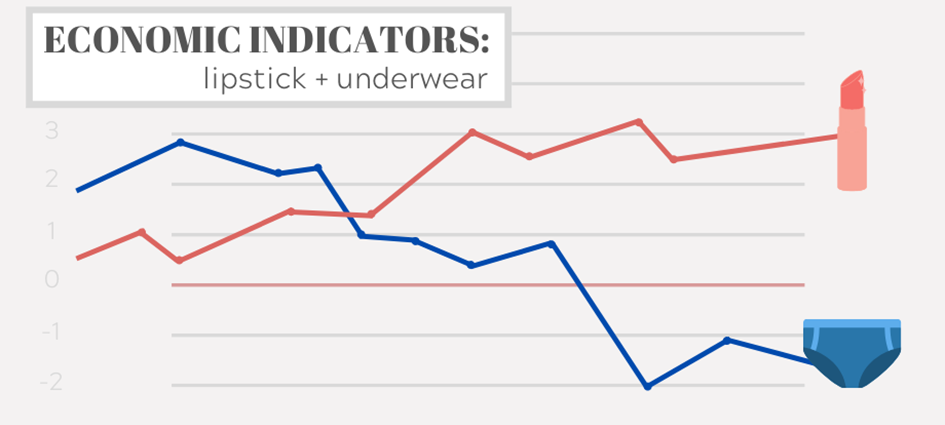
When consumer behavior and sentiment dictate how the economy will turn out, it’s no surprise that the sales trends of certain goods on the market can predict economic health. Everything from the height of women’s skirts to the price of Big Mac burgers says something about people’s finances. Community Columnist Felicia Mo explores two unconventional economic indicators – lipstick and men’s underwear – that economists use to signal and prepare for incoming recessions.
Continue Reading